
Life Sciences
Life science encompasses a broad spectrum of scientific research evaluating the complexities of biological systems. This field includes the study of living organisms (structure and function), their life processes (origin, growth, evolution, distribution), and their relationships to each other within an ecosystem and with their environments.
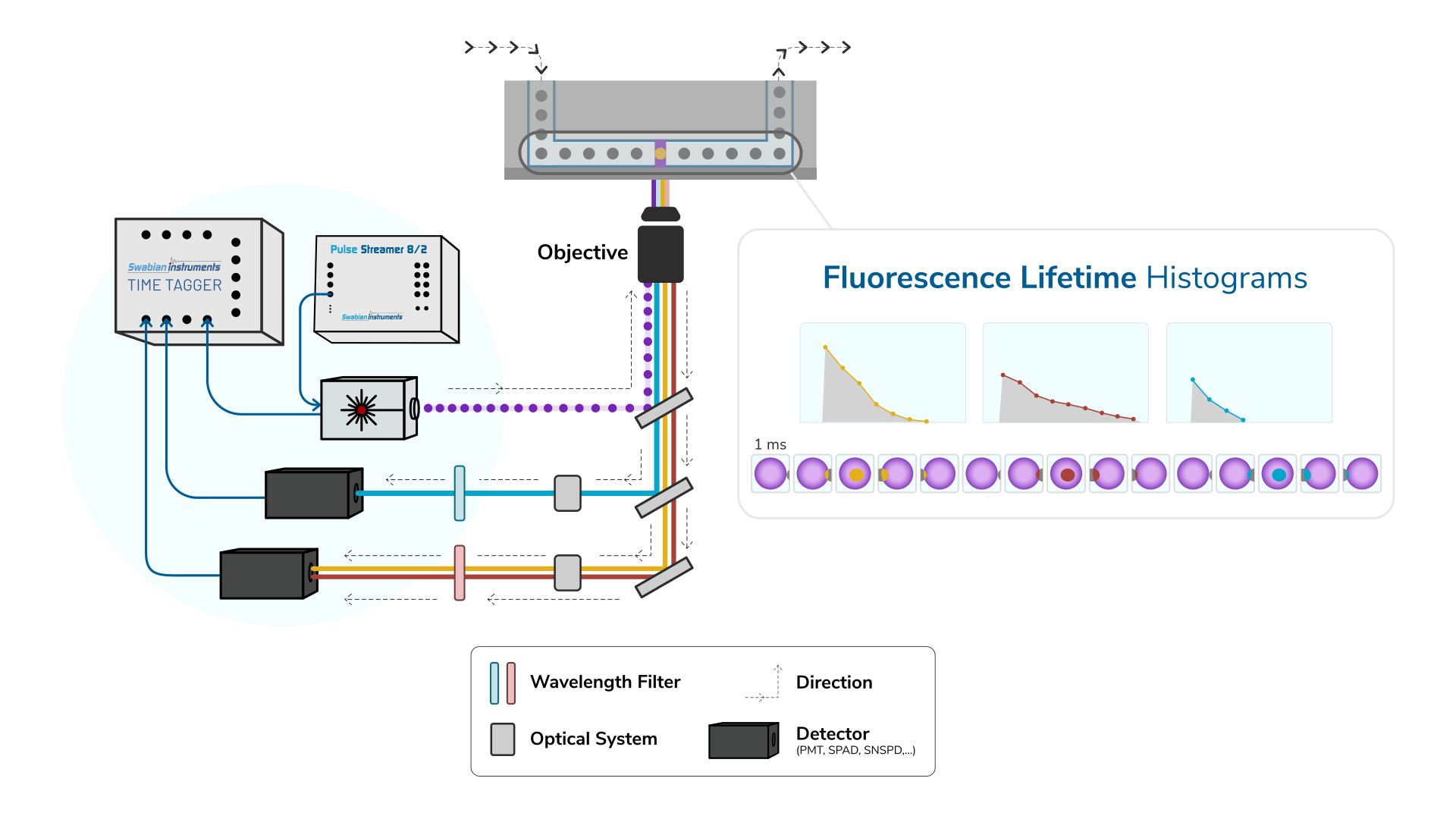
Fluorescence Lifetime Flow Cytometry (FLFC)
Flow cytometry is a sheath-flow-based technique that uses laser excitation and fluorescence to evaluate the physical and chemical characteristics of cells or other suspended particles in a fluid stream
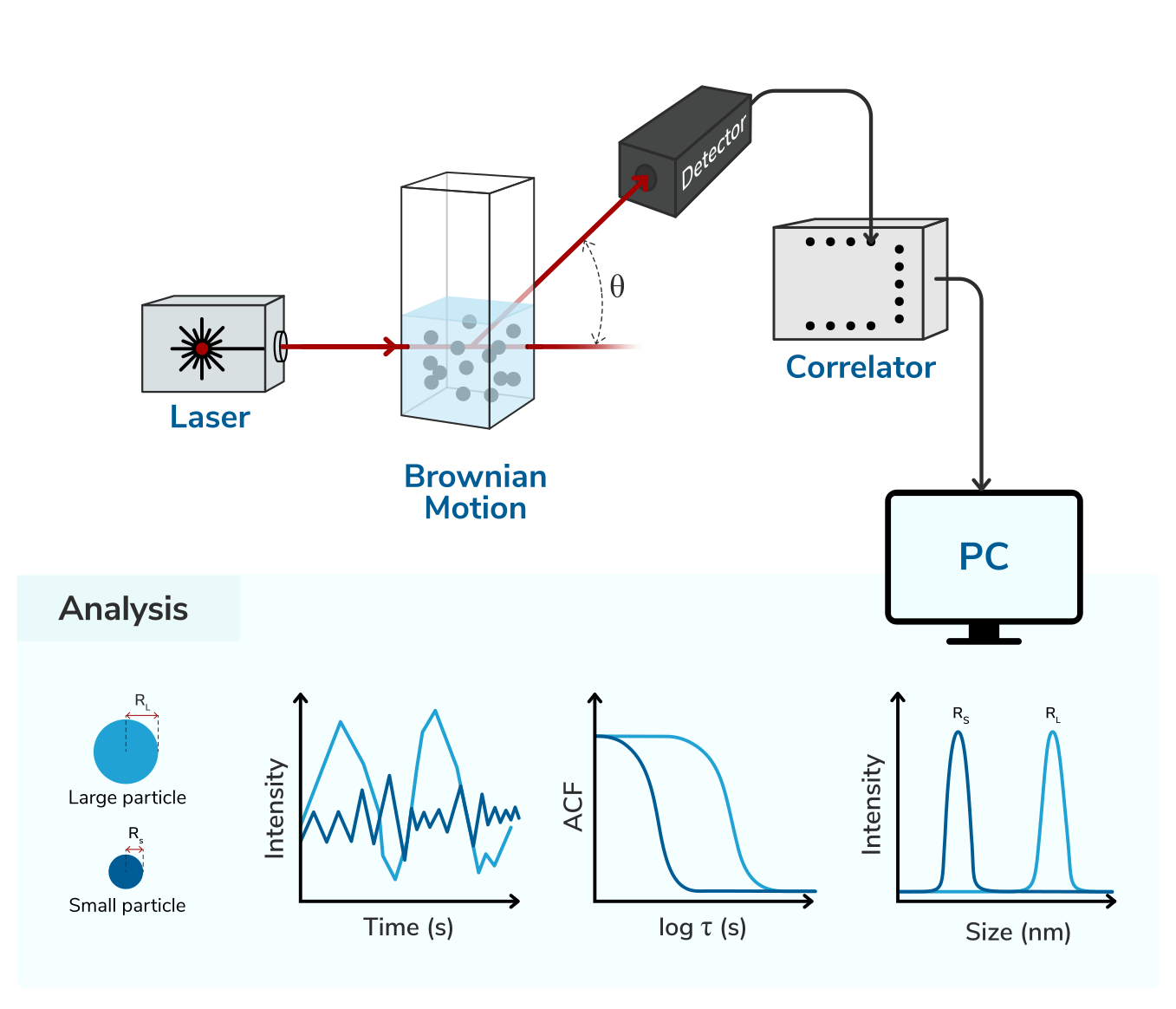
Dynamic Light Scattering (DLS) Particle Size Analysis
Next-generation multi-angle DLS turnkey design with built-in consistency checks, raw photon access, and intelligent spike filtering for fast, reliable particle sizing.
Single-Photon Counting Raman Spectroscopy
The single-photon counting Raman spectroscopy combines the principles of Raman spectroscopy with single-photon counting techniques, enabling the detection of weak Raman signals even at low analyte concentrations

Fluorescence Lifetime Imaging (FLIM)
Discover fluorescence lifetime imaging (FLIM), a powerful imaging technique for mapping fluorescence lifetimes with picosecond precision. Learn how Swabian Instruments' Time Taggers enable high-resolution FLIM measurements using advanced timing electronics, supporting detectors like PMTs, SPADs, and SNSPDs for cutting-edge research applications

Single Photon Microscopy
Did you ever wish you could save time by having all signals from your setup captured by one single device and made available to you by a versatile and intuitive software engine?
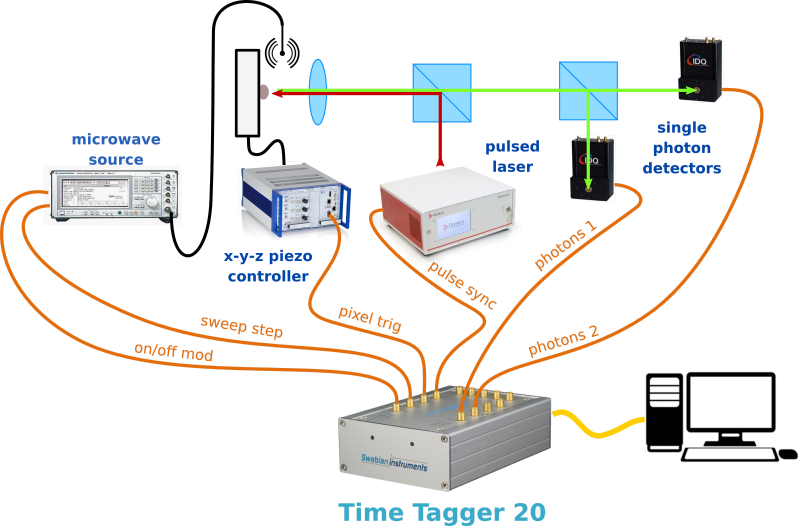
Time-Resolved Photoluminescence (TRPL)
Time-resolved photoluminescence (TRPL) is a powerful technique that measures the photoluminescence decay (emission lifetime) of materials after pulsed excitation, thereby probing their optical and electronic properties. By tracking how excited states relax back to the ground state, TRPL distinguishes between radiative and non-radiative pathways, yielding lifetimes that report on charge-carrier dynamics, trap/defect activity, and other loss mechanisms.
Life science encompasses a broad spectrum of scientific research evaluating the complexities of biological systems. This field includes the study of living organisms (structure and function), their life processes (origin, growth, evolution, distribution), and their relationships to each other within an ecosystem and with their environments. Breakthroughs in life sciences are required to advance healthcare, disease management, and our understanding of the fundamentals of life itself. By unraveling the mysteries of biological systems, life sciences research paves the way for innovative medical therapies, vaccines, and diagnostics, contributing significantly to enhancing life quality and extending life expectancy.
Swabian Instruments’ Time Taggers and time-correlated single photon counting (TCSPC) implementations are pivotal in life sciences as tools for studying cellular processes and molecular interactions with unmatched temporal precision via high-resolution fluorescence lifetime imaging and fluorescence correlation spectroscopy.