Year of Quantum: Swabian Instruments in New Mexico for IEEE Quantum Week 2025
on 19 September 2025
Swabian Instruments joined Single Quantum and Qunnect at IEEE Quantum Week 2025 (QCE25) in Albuquerque, showcasing how precise time-tagging supports scalable quantum networking, sensing, and communications.
Year of Quantum: Swabian Instruments in New Mexico for IEEE Quantum Week 2025
Swabian Instruments just returned from Albuquerque, New Mexico, after attending IEEE Quantum Week 2025 (QCE25). Taking place during the first week of September, it was packed with groundbreaking talks, hands-on workshops, and insightful conversations about the future of quantum technology. Beyond technical depth, the event gave us a chance to celebrate achievements in the field and deepen collaborations with our partners in the global quantum community.
On the Floor: Teaming Up With Partners in Quantum Networking
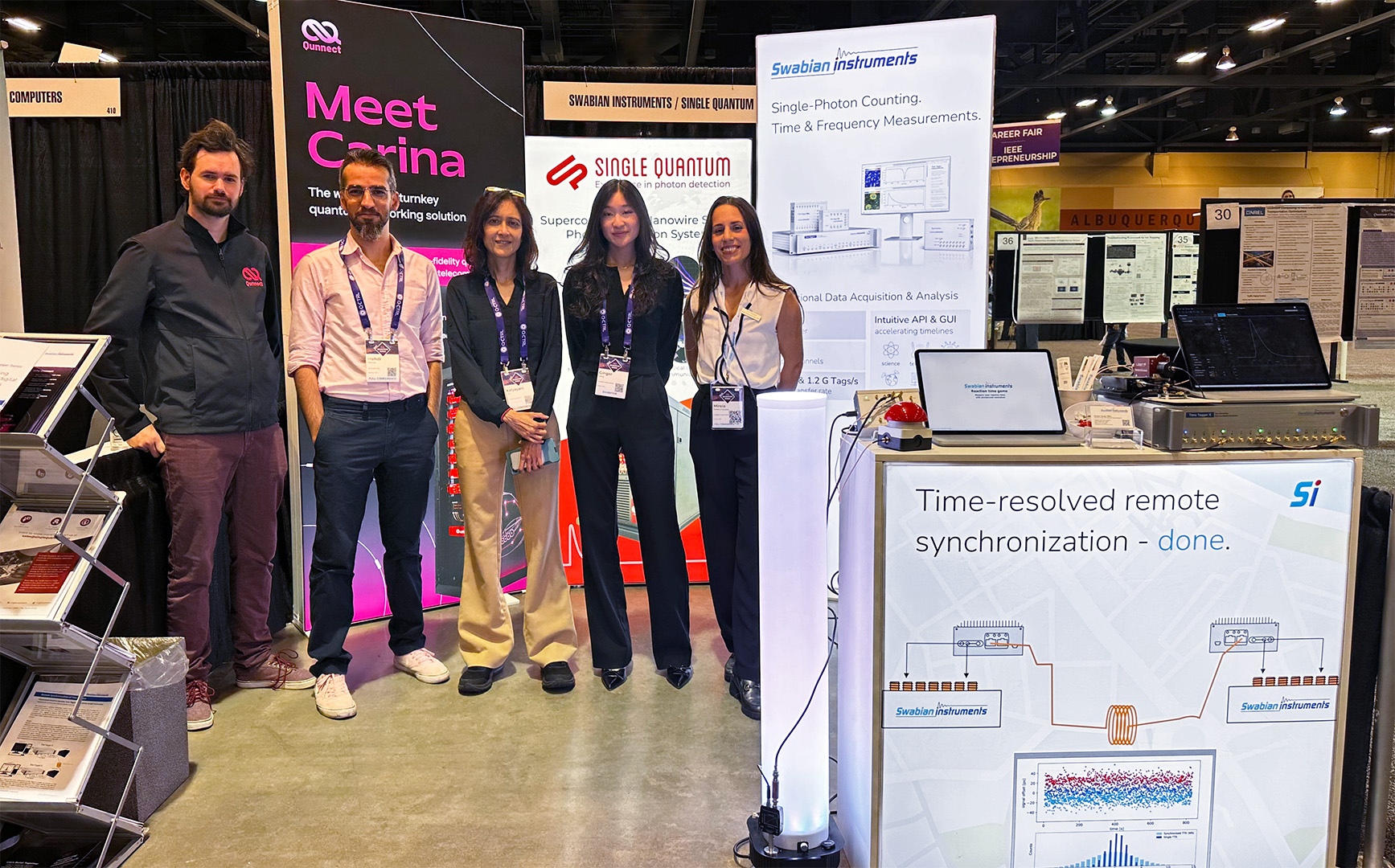
For the first time, we shared a booth with Single Quantum and Qunnect, two teams at the leading edge of single-photon detection and quantum networking. Single Quantum’s SNSPD platforms are recognized for very high detection efficiency and picosecond-scale timing, providing a clean, reliable detection layer. Qunnect’s Carina suite supplies the networking backbone with field deployed entanglement sources and stabilization tools proven on live testbeds (New York’s GothamQ and Berlin) and now rolling out at Montana State University for a campus-scale entanglement network.
At the heart of that architecture, Swabian Instruments ties the stack together through precise, high-fidelity time-tagging and synchronization, so teams can seamlessly correlate events across nodes and work from one coherent timeline.
We’re grateful to collaborate with partners whose strengths amplify our own, and together show how a coordinated platform turns great hardware into dependable, deployable, and scalable measurements.
Qunnect Workshop at QCE25: MSU’s Campus Fiber Goes Quantum
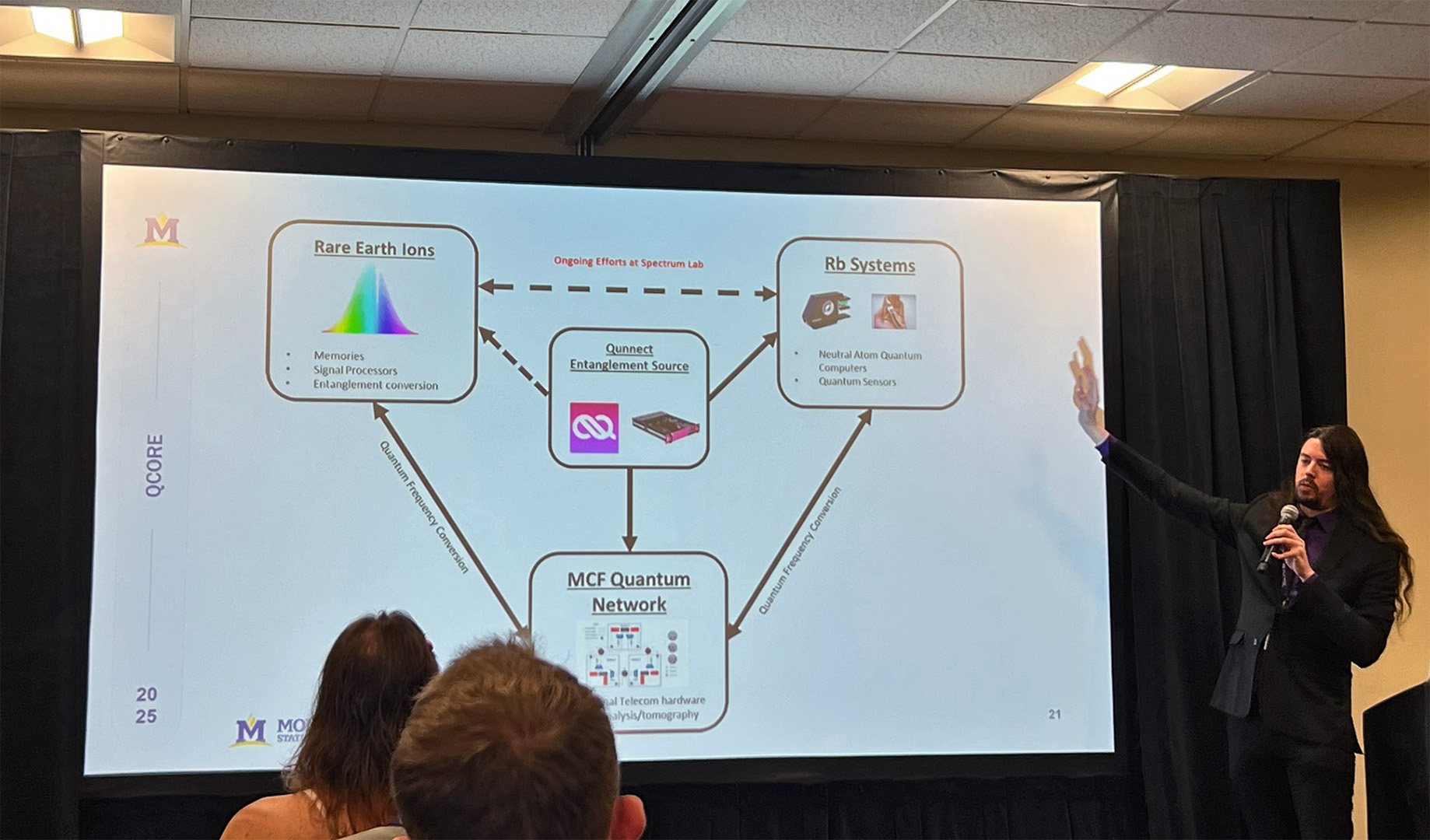
On Wednesday, we joined the Qunnect workshop, led by their chief scientific officer, Dr. Mehdi Namazi. The workshop highlighted real-world quantum networking deployments. We learned from Josh Dungré at the Spectrum Lab at Michigan State University and their focus on developing access to multiple quantum network testing platforms to shape the growth of the quantum internet. Their campus testbed uses existing telecom fiber to link labs via entangled optical channels. Collaborating with the Air Force Research Laboratory (AFRL), the program targets a multi-node operation that blends classical and quantum networking for synchronized, distributed experiments. Qunnect provides a rack-integrated source, timing, and validation layer that interfaces with SNSPDs, time taggers, and DWDM/White Rabbit timing
That evening, Qunnect also hosted a special networking event, bringing together researchers, startups, and telecom partners exploring the next phase of quantum secure communications.
Technology Experts and Nobel keynotes: Phillips, Wineland, and Simmons on Quantum and Photonics Advancements
We were honored to hear from William D. Phillips (NIST / University of Maryland Joint Quantum Institute) and David J. Wineland (NIST / University of Oregon) in a paired Nobel keynote at QCE25’s Kiva Auditorium. Phillips discussed how laser-cooled neutral atoms underpin today’s fountain clocks and cold-atom platforms, anchoring timekeeping in precise motion control. Wineland discussed trapped-ion control using light to isolate, cool, and interrogate single ions, sharing how precision metrology in these systems facilitates advances in atomic clocks and carries directly into quantum logic operations. Together, their talks connected decades of science to the building blocks of quantum computing, illustrating how, through the discipline of atoms and photons, scalable quantum architectures emerge.
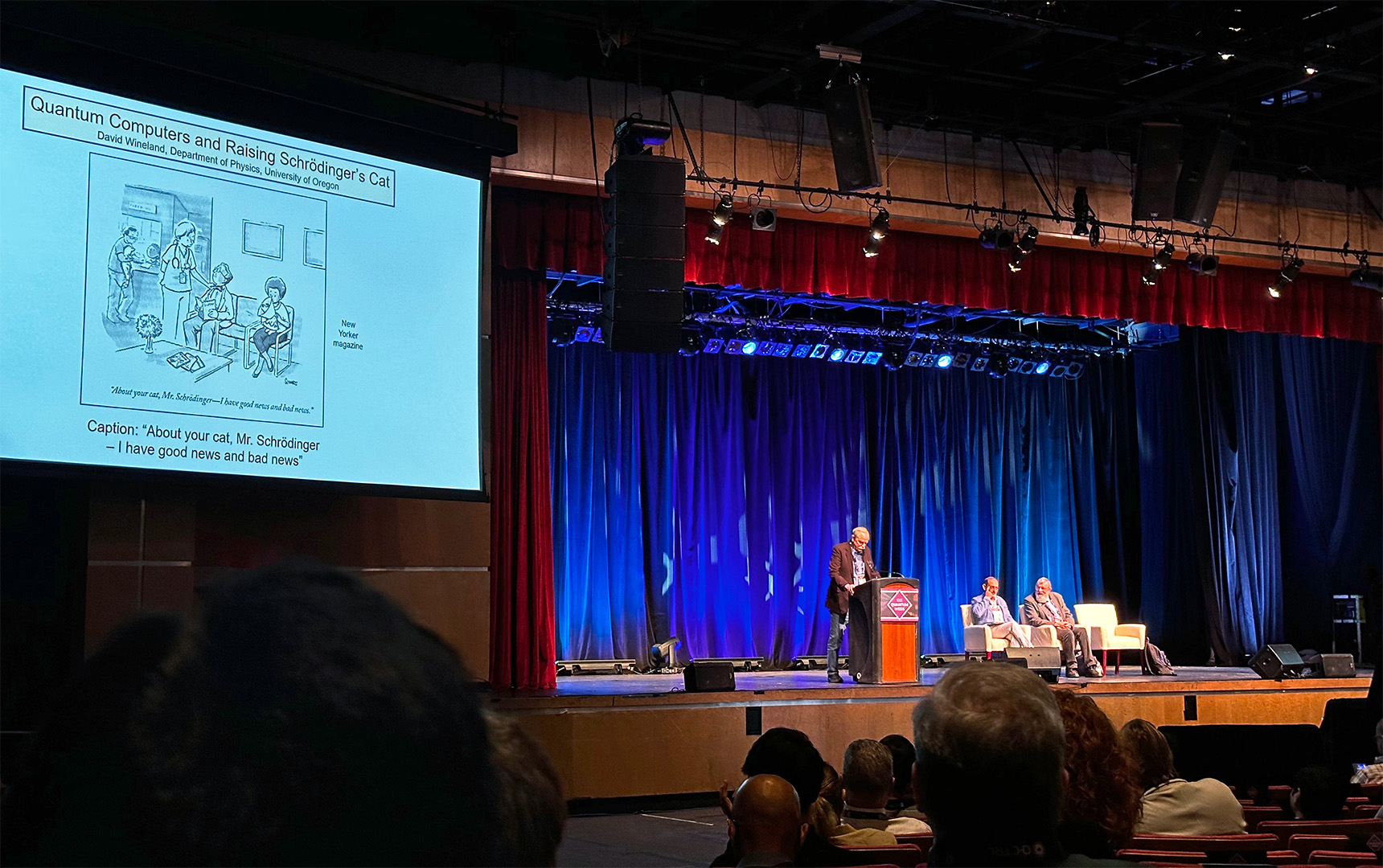
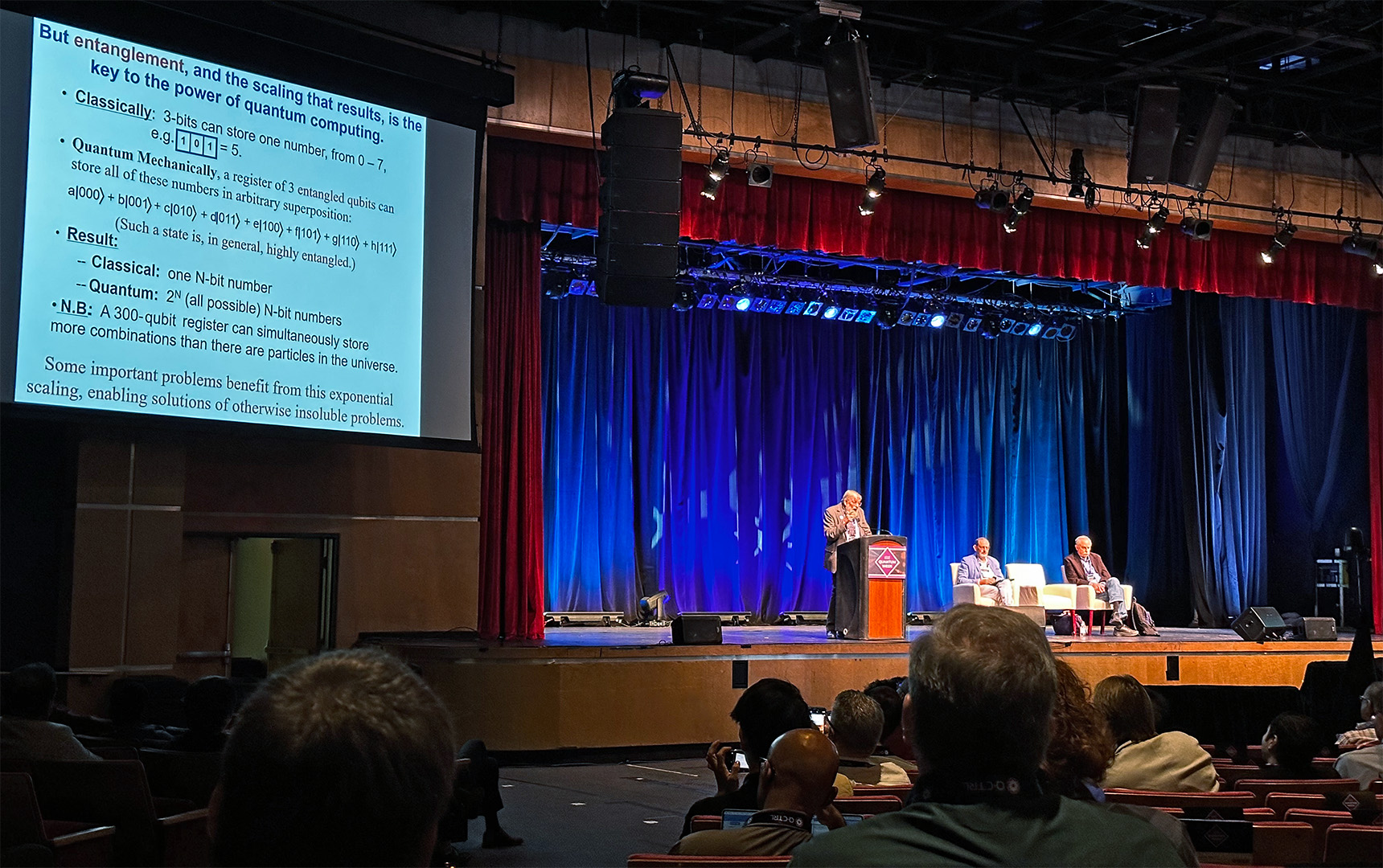
Closing night, Stephanie Simmons, Founder and Chief Quantum Officer at Photonic and Professor at Simon Fraser University, delivered the keynote address. She introduced an exciting architecture based on photonically linked silicon spin qubits, a scalable, cooling-free approach to entanglement generation that could transform how we design future quantum processors.
Thursday’s banquet featured a vibrant Noche de Flamenco en Burque show, reminding us that even in a highly technical week, there’s always space for cultural celebration. From pushing boundaries with our partners to Nobel Laureate reflections, IEEE Quantum Week 2025 reminded us of how fast we are advancing and how vital collaboration is in moving the field.
We left Albuquerque inspired, grateful for our partners, and more committed than ever to enabling cutting-edge quantum science with our systems. See you at the next conference!